Dr. Donald
Murphy
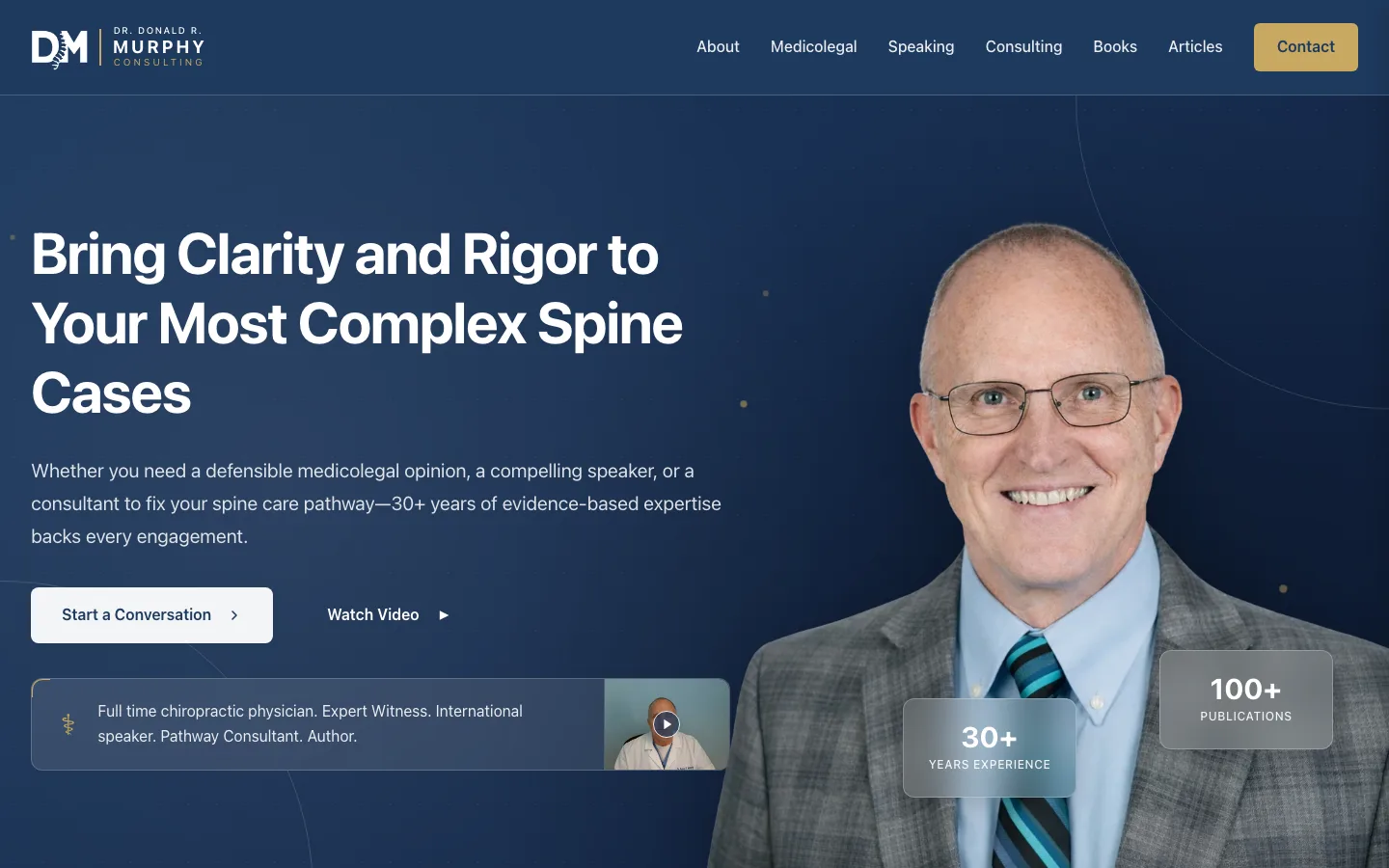
Dr. Donald R. Murphy, DC, FRCC is a Primary Spine Practitioner, author and international speaker. Brightwork built his professional home — a navy-and-gold, editorial site that presents his expertise to attorneys, health systems, universities and conference organizers, and that a search engine or AI assistant can read as cleanly as a person can.
Dr. Donald R. Murphy, DC, FRCC is a Primary Spine Practitioner, author and international speaker. Brightwork built his professional home — a navy-and-gold, editorial site that presents his expertise to attorneys, health systems, universities and conference organizers, and that a search engine or AI assistant can read as cleanly as a person can. Authoritative on the surface, carefully engineered underneath, and deliberately kept apart from his patient practice.
Two audiences, one expert
Dr. Murphy does two very different kinds of work. He treats patients, and he advises attorneys, health systems and universities. Those audiences need completely different things — a patient wants a nearby clinic and a friendly first appointment; a lawyer wants a credible expert witness with a hundred peer-reviewed publications behind him. One site trying to speak to both would serve neither.
So the brief was narrow and deliberate: build the site for the professional audience — "Independent Spine Expertise for Medicolegal, Healthcare Systems, Seminars and Workshops" — and keep patients elsewhere on purpose. His patient clinic, Rhode Island Spine Center, is a separate site with its own brand, its own tone, and its own case study. One clinician, two brands, two audiences.
One clinician, two brands. This site is built for the people who hire a spine expert — not the ones who come to be treated.
— the brief, in a lineResponsive from the brief
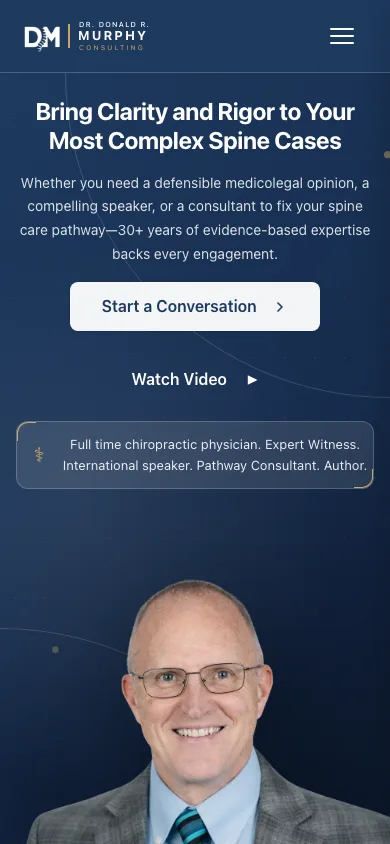
Attorneys and administrators read on phones between meetings, so the site was built to hold its authority on the small screen — the same navy hero, the same portrait, the same clarity, on the device a busy professional actually has in hand.
Navy, gold, and authority
The look was a deliberate choice, internally codenamed "Variation C — Navy Professional": deep navy (#1e3a5f) with gold (#c9a961) hairlines, generous white space, a gold vertical divider in the wordmark, concentric-circle motifs and alternating section bands. It reads as editorial and considered — NEJM or McKinsey, not a startup — which is exactly the register that signals credibility to a lawyer or a hospital administrator.
Underneath the calm surface is real craft. The site runs on a 7,000+ line hand-authored vanilla-CSS design system with no UI frameworks and no web fonts — a fast system-font stack instead — plus IntersectionObserver scroll choreography and a multi-surface intro-video system. It's built to feel premium and load instantly, both at once.
◇ For engineers The system-font stack, ~7 KB of scroll JS, and a Google-Sheets talks feed
There are no web fonts. The type is set in a system-font stack, so there is nothing to download and no FOUT — the first paint is the final paint. On a credibility site read on hotel Wi-Fi between depositions, "instant and stable" beats a bespoke typeface.
The motion is deliberately cheap: scroll-reveal
and the animated stat circles run on
IntersectionObserver in roughly 7 KB of vanilla
JavaScript — no framework, no hydration cost, and it
all degrades gracefully with prefers-reduced-motion.
And a quietly useful detail: the live "Upcoming Talks" panel is fed from a Google Sheet, so Dr. Murphy's team can add a new keynote or workshop by editing a spreadsheet — no deploy, no developer — and the site picks it up.
One expert, four ways to engage
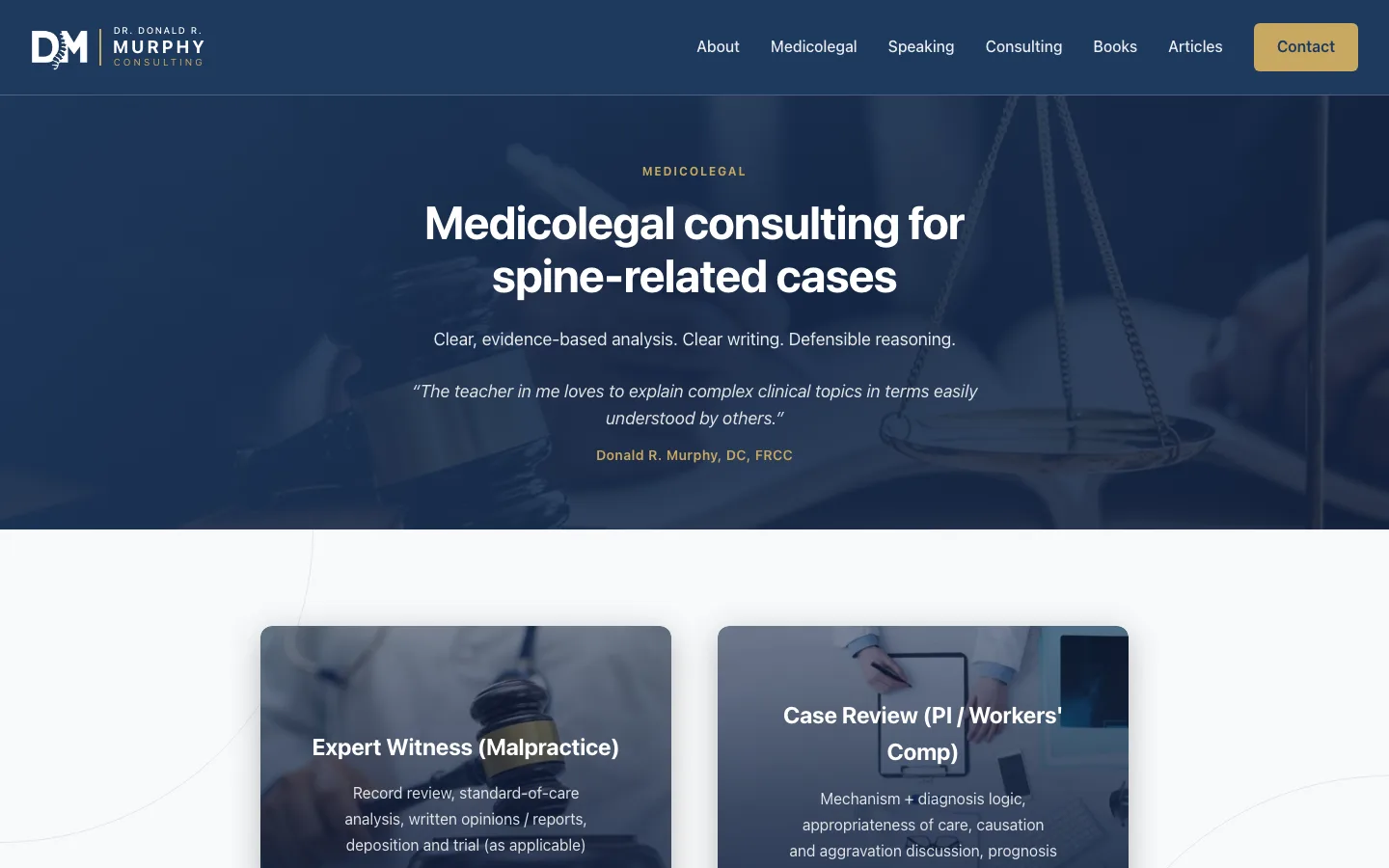
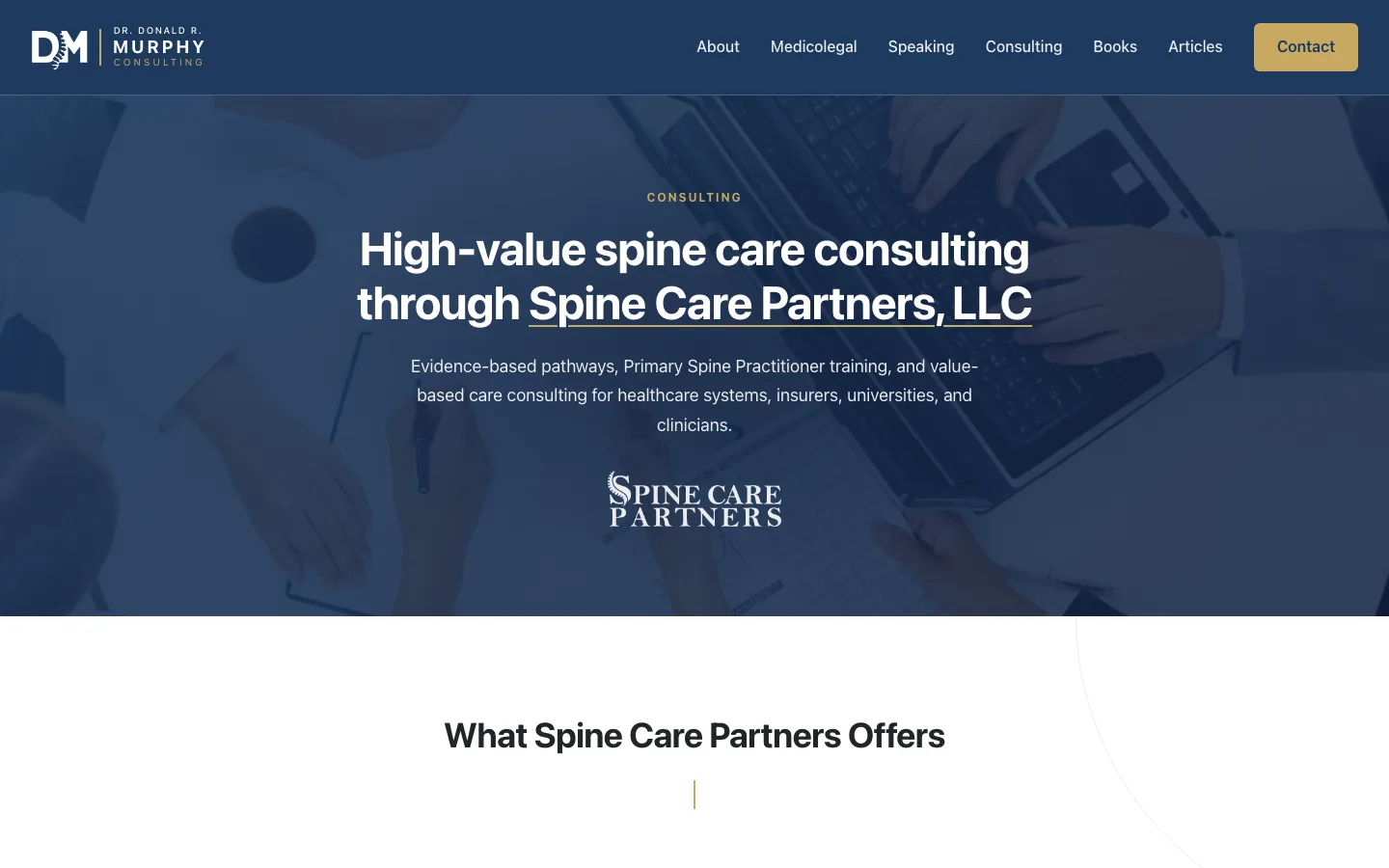
Dr. Murphy's professional work resolves into four service surfaces, and Brightwork built each as its own page with tailored copy and its own structured data. Medicolegal covers Expert Witness work for malpractice plus Case Review for personal-injury and workers' compensation — "clear rationale, layperson explanation, cited written report." Consulting is routed through Spine Care Partners, LLC — pathway implementation, Primary Spine Provider training and value-based-care advice.
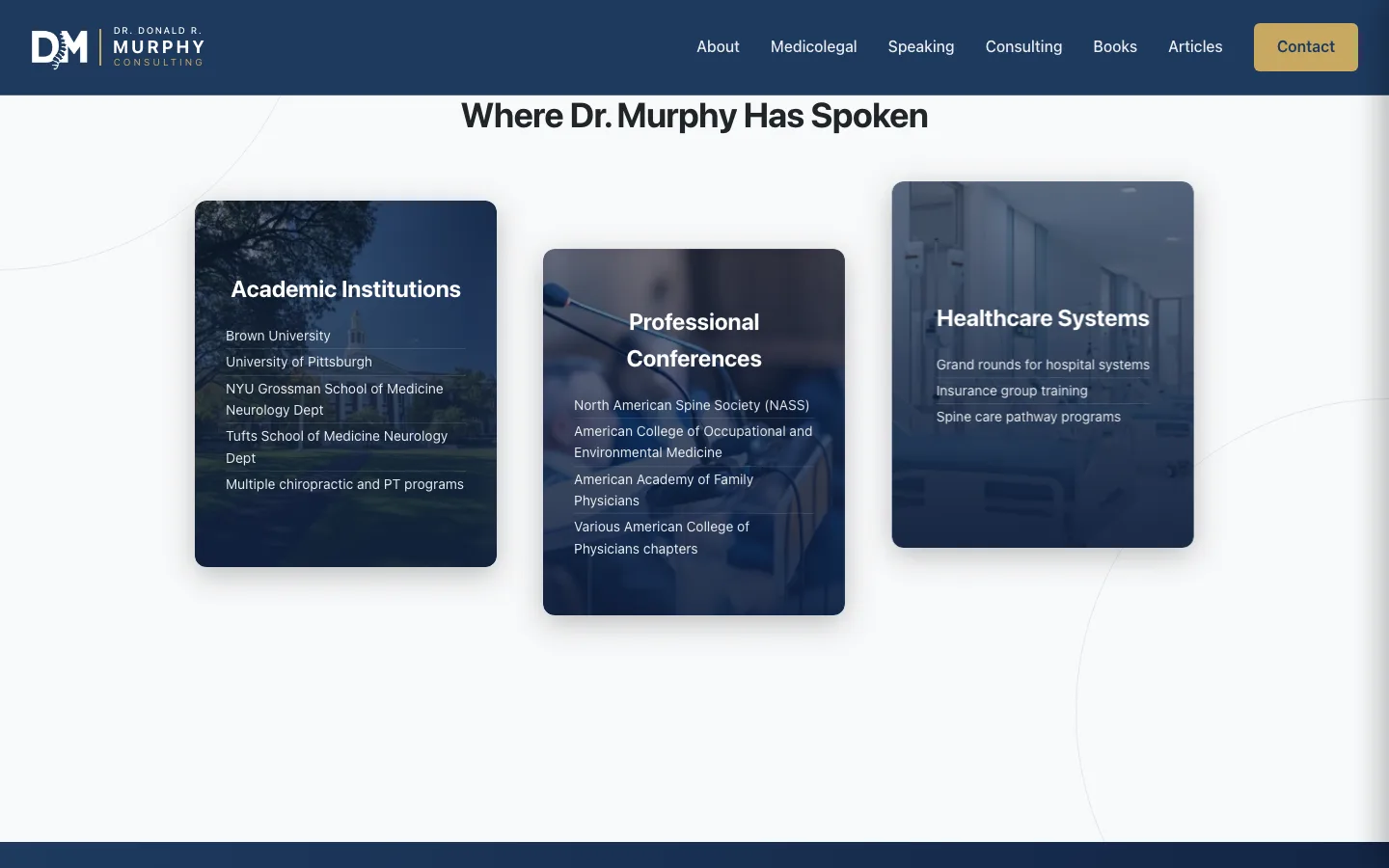
Speaking gathers his keynotes, grand rounds, workshops and webinars behind a real venue list — Brown University, the University of Pittsburgh, NYU Grossman, Tufts, and conferences including NASS, ACOEM, AAFP and ACP. And Books presents his authored works. Four distinct audiences, four tailored pages, one coherent professional identity.
The idea underneath: CRISP®
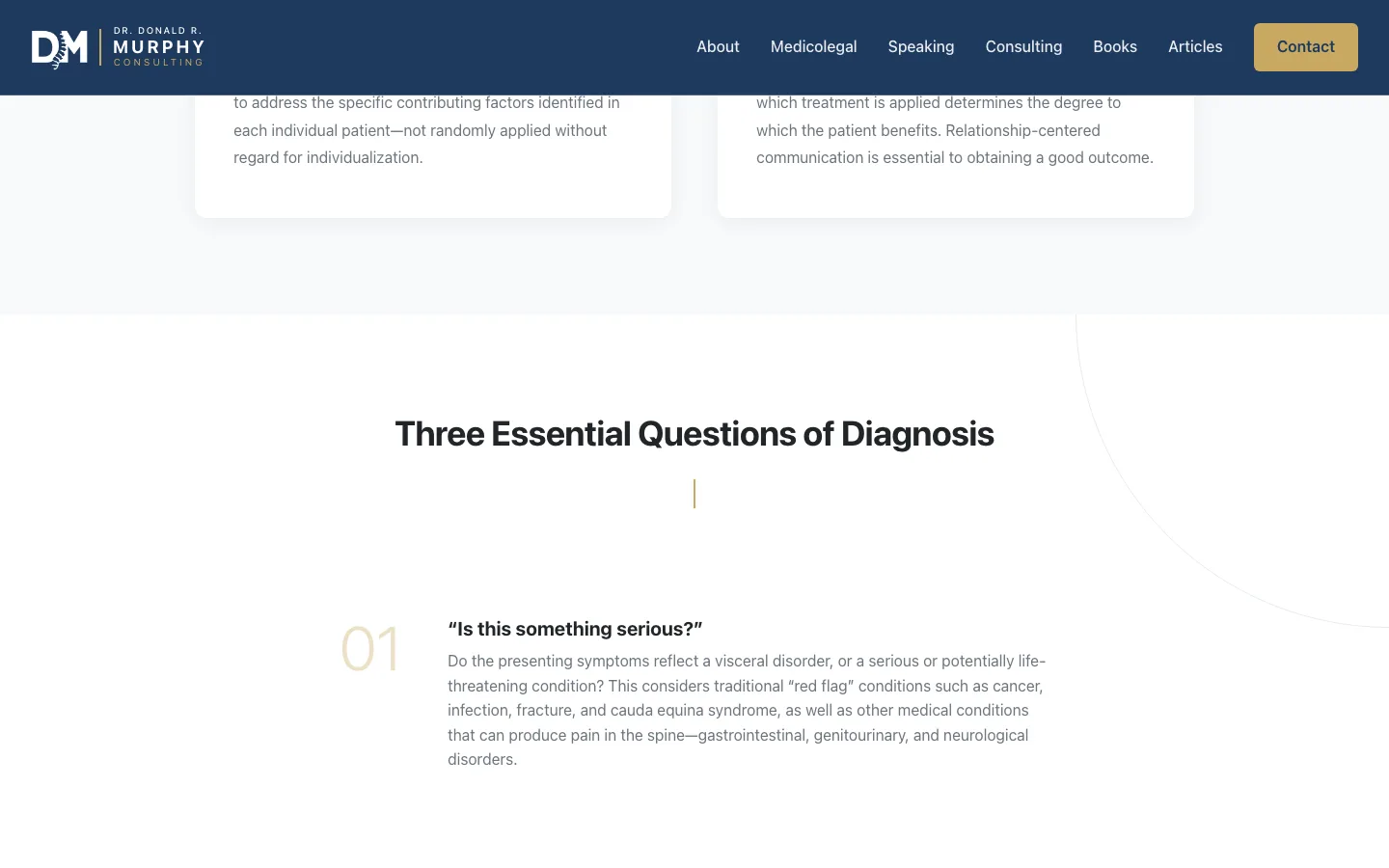
One idea threads through the whole site: CRISP® — Clinical Reasoning in Spine Pain® — Dr. Murphy's diagnostic framework. Its spine is the Three Essential Questions of diagnosis: "Is this something serious?", "Where is the pain coming from?" and "What's driving the pain experience?" It's the throughline that makes his medicolegal, teaching and consulting work read as one coherent body of thought rather than four separate services.
This part of the site also became the permanent home for a retired domain: when crispeducationandresearch.com was wound down, its content and 15 redirects were preserved here, so years of links and citations still resolve instead of breaking.
Engineered to be found — by people and machines
This is a site built for the answer-engine era. Underneath the calm navy pages is a deep layer of structured meaning: 9+ distinct Schema.org types — Person (with credentials and affiliations), ProfessionalService, HowTo, Book / ItemList, Article, FAQPage, BreadcrumbList, ContactPage and WebSite — so a machine can read exactly who Dr. Murphy is and what he offers.
On top of that sits an answer-first article system
— a content collection with a Zod schema, per-article FAQPage
JSON-LD, and a mandatory cited-sources discipline
pointing to PubMed / PMC / DOI — plus a hand-authored
llms.txt summarising who he is for AI
assistants, and IndexNow for fast indexing. Put
plainly: when an attorney asks ChatGPT
"who's a good spine expert witness," this is the site
engineered to be the answer.
◇ For engineers The schema inventory, llms.txt + robots allow-list, and AEO discipline
The schema inventory is deliberate and typed:
Person (with hasCredential and
affiliation), ProfessionalService,
HowTo (the Three Questions),
Book/ItemList, Article,
FAQPage, BreadcrumbList,
ContactPage and WebSite — 9+ types
emitted as JSON-LD across the relevant pages.
A hand-authored llms.txt summarises
who Dr. Murphy is and what he offers, and the
robots.txt carries an explicit
allow-list for GPTBot, ChatGPT-User, Claude and
Perplexity — an intentional welcome to the assistants
professionals actually ask, while the sitemap
filters out legal / boilerplate pages so only
the substantive surfaces are advertised.
The article system enforces AEO discipline: an
answer-first lead paragraph, and a
byte-identical FAQ answer shared between the
visible copy and the FAQPage JSON-LD, so the machine
answer and the human answer can never drift apart. An
IndexNow key file pings search engines the
moment a page changes.
Sending patients to the right door
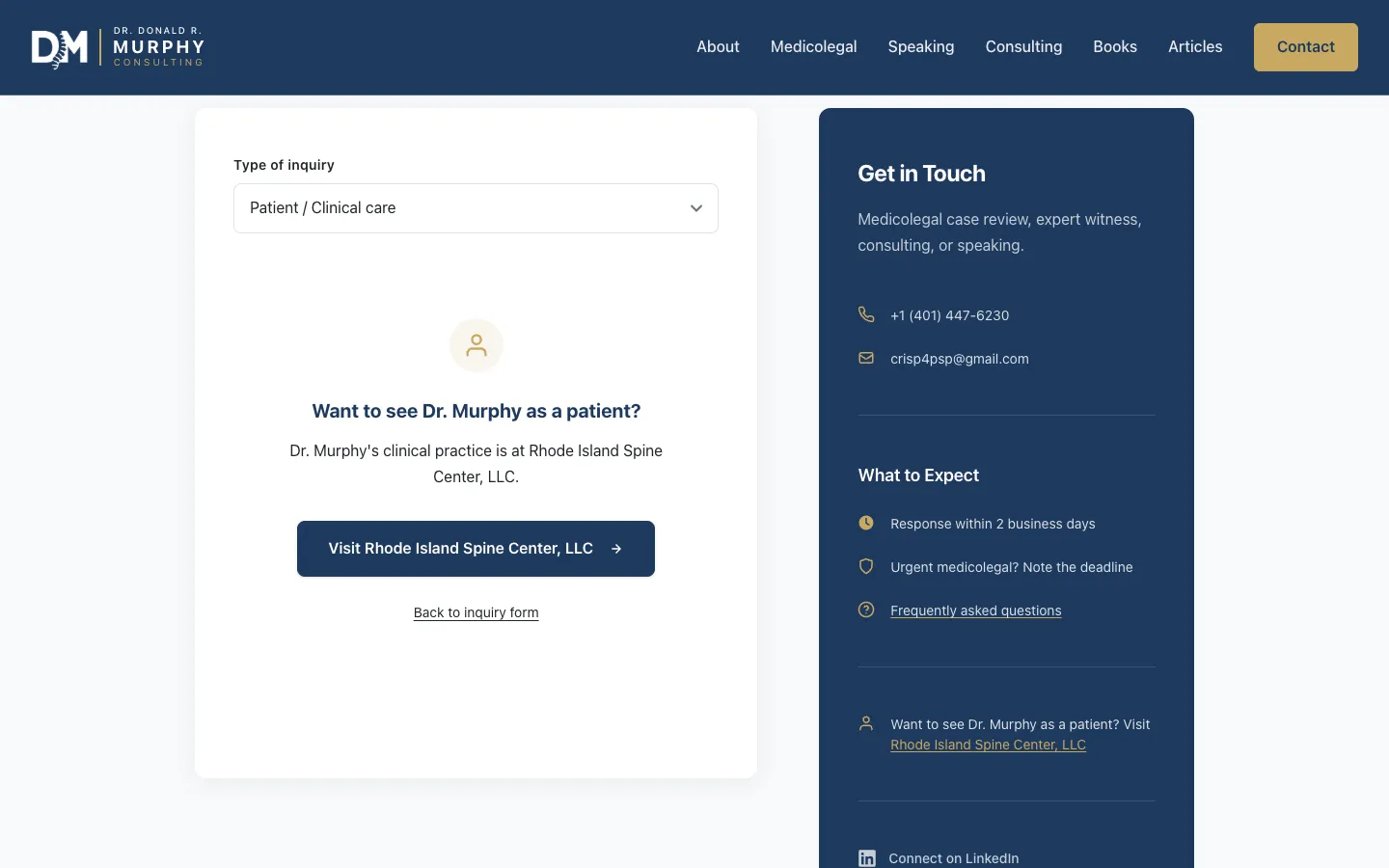
The two-audience problem gets its cleanest expression at the contact form, which is state-driven. Choose "Medicolegal" and a required Deadline field appears — because a legal enquiry lives and dies by dates. Choose "Patient / clinical care" and the professional form is replaced entirely by a card that redirects to Rhode Island Spine Center. Nobody gets the wrong form; every enquiry reaches the right place.
That's the firewall in miniature: his personal brand and his clinic are two sites on purpose — different audiences, different tone, one coherent professional identity. The clinic has its own case study, and the two are built as deliberate counterparts.
Built by a team of AI agents
The site began as a static-HTML → Astro migration and was rebuilt and maintained the way Brightwork builds everything — with a coordinated team of AI agents, orchestrated by Loom on GitHub. Every task became an issue, built on its own branch, reviewed as a pull request, and merged when it was clean. Over the build that added up to roughly 77 commits, each one auditable.
The assembly line
A task is filed on GitHub — a feature, a fix, an idea.
An agent enriches it into a clear, buildable spec.
A builder agent implements it in an isolated worktree, opens a PR.
A judge agent reviews the PR for quality and safety.
A champion agent merges it — and the change ships.
The result is a build process that's fast, parallel and — crucially — auditable: every decision lives in a pull request you can still read. And in the same spirit, this very case study was built the same way, as a tracked GitHub issue run through a Loom cycle.
◇ For engineers The Loom role model
Loom coordinates agents through GitHub as the shared source of
truth, with one git worktree per issue (branch
feature/issue-N) so agents work in parallel without
colliding. Labels drive the state machine
(loom:issue → loom:building →
loom:review-requested → loom:pr). The
roles:
- Curator enriches a raw idea into a spec-ready issue
- Builder implements it in an isolated git worktree, opens a PR
- Judge reviews the PR for quality, security & correctness
- Champion auto-merges once it is clean and mergeable
- Hermit hunts down complexity and proposes removing it
Governance is deliberate: a capped number of parallel agents, no unattended daemon, and auto-merge restricted to pull requests GitHub reports as genuinely mergeable and clean.
The result
Dr. Murphy's professional home is live at drdonaldmurphy.com: a fast, authoritative brand that presents a spine expert to the audiences who hire him — attorneys, health systems, universities and conference organizers — and that reads cleanly to search engines and AI assistants. Authoritative on the surface, deeply engineered underneath, and firewalled from his patient practice by design.
A navy-and-gold editorial design system, 7,000+ lines of hand-authored vanilla CSS — no frameworks, no web fonts.
9+ Schema.org types, an llms.txt for AI assistants, IndexNow, and an answer-first, source-cited article pipeline.
An Astro 6 static build on Vercel, ~77 commits by AI agents, every change filed, reviewed and merged as a PR.
What we built
- Vanilla-CSS design system 7,000+ hand-authored lines — navy + gold, no UI frameworks
- No web fonts a fast system-font stack — no FOUT, nothing to download
- Scroll choreography IntersectionObserver reveals + animated stat circles in ~7 KB of JS
- Editorial register "NEJM/McKinsey, not startup" — credibility for lawyers & administrators
- 9+ Schema.org types Person, ProfessionalService, HowTo, Book, Article, FAQPage & more
- llms.txt a hand-authored summary written for AI assistants
- IndexNow fast search-engine indexing the moment a page ships
- Answer-first articles content collection with per-article FAQPage JSON-LD + cited sources
- State-driven contact form fields adapt to the enquiry; patients are redirected out
- Live talks feed "Upcoming Talks" fed from a Google Sheet — no deploy to update
- Book catalogue real covers, ISBNs and buy links, emitted as Book structured data
- Redirects preserved the retired crispeducationandresearch.com domain, kept alive
- Astro 6 static SSG pre-rendered and deployed on Vercel
- Accessibility semantic headings, alt text, keyboard-navigable
- Fully responsive designed for the phone as well as the desk
- Loom + GitHub AI agents building through issues & pull requests
The other half of the story
Sibling case study The other half of the story — Dr. Murphy's patient clinic
Same clinician, opposite audience. Rhode Island Spine Center is
the patient-facing side of the firewall — a separate site, a
separate design system, its own case study.
Read the Rhode Island Spine Center case study
This is what Brightwork does for professional clients: an authoritative brand, engineered so the right people — and the right machines — find it first.
Visit the live site